
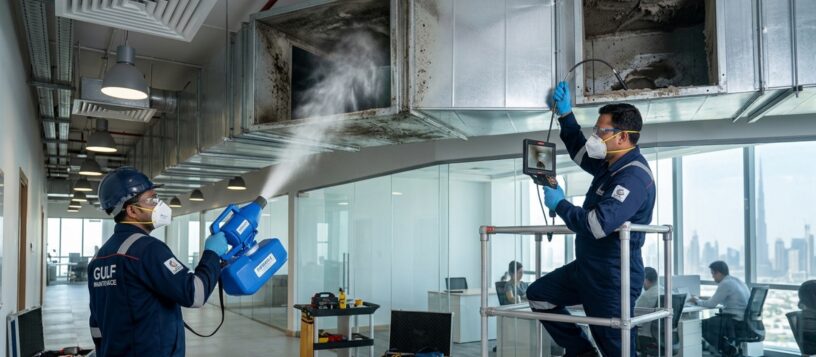
Every building in Dubai depends on its HVAC system to maintain comfortable and breathable indoor air. This system runs continuously, pulling air from outside, conditioning it, and circulating it through every room and floor. Most building managers maintain the mechanical side regularly servicing compressors, replacing filters, and checking cooling performance. What often gets ignored is the biological side. Dust, mold spores, bacteria, and moisture accumulate inside ducts and components over time. This contamination does not stay in the ductwork. It travels through the air supply and reaches every occupant in the building every single day.
Dubai’s extreme heat and humidity make this problem worse than in most other climates. Air conditioning runs almost year-round, which means contaminants build up faster and microbial growth spreads more aggressively. Knowing the warning signs helps we act before the problem affects occupant health, energy costs, and air quality across our entire building.
Persistent Bad Odors Coming From Air Vents
One of the earliest and most obvious signs of a contaminated HVAC system is a bad smell coming from the vents. This odor is often musty, stale, or similar to mildew. It appears that the moment our system turns on, it spreads throughout the building within minutes.
This smell points directly to mold or bacterial growth inside our ductwork. When moisture accumulates inside ducts, which happens easily in humid conditions, it creates a surface where microbial colonies grow rapidly. Every time the fan runs, it pushes these odors and microscopic particles into our air supply.
A simple filter change will not solve this problem. The source lives inside the ducts themselves, and only professional sanitization and disinfection can eliminate it.
Visible Dust and Debris Blowing From Vents
If we notice dust clouds or debris particles coming out of our air vents, our HVAC system needs immediate attention. Clean ducts do not release visible particles into the air. When we see this happening, it means our duct system carries a heavy buildup that has gone well past the normal maintenance threshold.
This buildup includes:
- Settled dust and dirt from years of continuous circulation
- Dead skin cells, hair, and organic debris are trapped inside the ducts
- Pollen and outdoor contaminants are pulled through the intake points
- Mold fragments and spores are released from microbial colonies
- Construction dust from nearby renovation or demolition activity
Each of these particles travels directly from our ducts into our breathing space. Occupants with allergies, asthma, or respiratory sensitivities feel this immediately. Professional HVAC sanitization removes this buildup and restores clean airflow throughout our building.
Rising Cases of Illness Among Building Occupants
When multiple people in the same building start reporting similar symptoms of headaches, sore throats, eye irritation, fatigue, or frequent colds the HVAC system becomes a prime suspect. This pattern has a formal name: Sick Building Syndrome.
Our HVAC system connects every room and floor in our building through a shared air supply. If bacteria, mold, or viruses enter this system, they spread everywhere simultaneously. A single contaminated duct section can expose every occupant to the same biological threat.
This becomes especially critical in commercial buildings, offices, hospitals, schools, and residential towers where large numbers of people share the same air. Professional HVAC sanitization and disinfection eliminate these biological threats and protect the health of every person inside our building.
Key Warning Signs That Demand Immediate HVAC Action
Mold Growth Around Vents and Grilles
Mold visible around vent covers or on the ceiling near air supply grilles is a serious warning sign. This external mold means contamination inside our ductwork has become severe enough to push spores outward in large quantities. Surface mold near vents almost always means significantly more mold sits deeper inside the duct system. Cleaning the visible surface without treating the interior source will not resolve the problem. The mold returns within weeks without proper disinfection treatment applied to the full duct interior.
Rising Illness Cases Among Building Occupants
When multiple people in the same building start reporting similar symptoms of headaches, sore throats, eye irritation, fatigue, or frequent colds the HVAC system becomes the prime suspect. This pattern carries a formal name: Sick Building Syndrome. Our HVAC system connects every room and floor through a shared air supply. If bacteria, mold, or viruses enter this system, they spread to every occupied area simultaneously. A single contaminated duct section exposes every occupant to the same biological threat without anyone realizing the source.
Weak or Inconsistent Airflow Across Rooms
When some rooms receive strong airflow, and others receive almost none, heavy dust and biological buildup inside ducts create blockages that restrict circulation to specific zones. Occupants in poorly served areas receive less conditioned air and often lower the thermostat to compensate, which increases energy consumption without fixing the real problem. Beyond comfort, reduced airflow creates stagnant air zones inside our building. Stagnant air traps pollutants, increases local humidity, and accelerates microbial growth in corners and rooms that receive less circulation.
Increased Energy Bills Without Explanation
A sudden and unexplained rise in our energy bills often connects directly to HVAC hygiene. When dust, dirt, and microbial buildup coat internal surfaces, especially evaporator coils, blower fans, and heat exchangers our equipment works much harder to move the same volume of air. Dirty coils lose their heat transfer efficiency. Our system runs longer cycles to reach the same temperature, and energy consumption increases significantly while performance drops at the same time. After professional HVAC sanitization and disinfection, most building operators see a measurable reduction in energy costs.
High Indoor Humidity Despite Running AC
Our air conditioning system removes moisture from the air as part of normal operation. When contamination builds up on evaporator coils or inside drain pans, this moisture removal becomes less effective. The result is a building that feels humid and sticky even when the AC runs continuously. High indoor humidity accelerates mold growth on walls and ceilings, makes the air feel warmer than it actually is, and causes condensation on windows and surfaces that damage building materials over time. If our building feels persistently humid, schedule professional HVAC sanitization immediately.
Extended Period Without Professional HVAC Cleaning
If our building’s HVAC system has not received professional sanitization and disinfection in the past 12 to 24 months, biological contamination is almost certainly present regardless of how well the system performs mechanically. Routine filter changes and mechanical servicing do not reach the interior duct surfaces, coil fins, drain pans, or blower components where biological growth accumulates.
In Dubai’s climate, annual professional sanitization is the minimum recommended standard. Buildings with high occupancy, food preparation areas, medical facilities, or heavy outdoor air intake require more frequent treatment. Waiting for visible symptoms to appear before scheduling service means our occupants have already experienced extended exposure to contaminated air.
Recent Renovation or Construction Work in the Building
Any renovation, demolition, or construction activity inside or near our building pushes enormous quantities of fine dust, debris, and chemical particles into the air. Our HVAC system draws this contaminated air through its intake points and deposits the particles throughout our duct network. Even with temporary dust barriers in place, a significant amount of construction-related contamination enters HVAC systems during renovation projects.
This includes concrete dust, insulation fibers, wood particles, adhesive fumes, and paint vapors. Once these particles settle inside the ductwork, they continue to circulate through our building every time the system runs. Professional HVAC sanitization after any construction or renovation work is not optional. It is a necessary step to protect occupant health and restore air quality before the building returns to normal operation.
After a Flooding or Water Damage Event
Water intrusion from roof leaks, pipe bursts, or flooding creates immediate and severe contamination risks for HVAC systems. Water that enters the ductwork or reaches HVAC components introduces bacteria, sewage particles, and organic material that begin to grow within 24 to 48 hours under normal temperature conditions.
A building that has experienced any water damage event must have its HVAC system inspected, cleaned, and disinfected before it operates again at full capacity. Running a contaminated system after water damage spreads biological material to every area of the building through the air supply. Gulf Maintenance provides emergency HVAC sanitization and disinfection services for exactly these critical situations.
How Professional Sanitization and Disinfection Works
Initial Inspection and Contamination Assessment
Technicians begin with a full inspection of the duct network, air handling units, coils, fans, filters, and drain pans. They document the contamination level and identify any areas of mold growth, moisture accumulation, or structural damage that affects system hygiene. This assessment determines the exact treatment plan our building requires.
Mechanical Cleaning With HEPA Filtration
After inspection, technicians remove loose debris using high-powered vacuum equipment connected to HEPA filtration systems. This process prevents removed particles from re-entering the building air during cleaning. Every dislodged contaminant goes directly into sealed containment without spreading to occupied spaces.
Antimicrobial Treatment and Disinfection
Following mechanical removal, technicians apply antimicrobial and disinfectant agents onto all internal surfaces. These agents eliminate bacteria, mold, fungi, and viruses at a biological level. The treatment covers duct interiors, coil surfaces, drain pans, blower components, and grille surfaces where microbial colonies establish themselves most aggressively.
Protective Coating Application
The final stage involves applying a protective coating to key surfaces. This coating slows future microbial growth and extends the time between required treatments. Every step follows Dubai Municipality and international air quality standards to ensure our building meets all regulatory hygiene requirements.
Why Buildings in Dubai Need More Frequent HVAC Sanitization
Dubai’s climate pushes HVAC systems harder than almost any other city in the world. Outdoor temperatures cross 40 degrees Celsius for months at a time, which forces buildings to run air conditioning almost continuously. This non-stop operation means our system processes massive air volumes daily, collecting dust, moisture, and contaminants inside ducts at a much faster rate than buildings in cooler climates.
High outdoor humidity adds moisture to the duct interior, creating ideal conditions for mold and bacterial growth. Fine desert sand and dust particles enter through intake points and carry organic matter that accelerates biological buildup when combined with condensation. Standard international cleaning intervals of two to three years simply do not apply here. Annual professional HVAC sanitization and disinfection is the minimum practical standard for any occupied building in Dubai.
Why Gulf Maintenance Is the Right Choice for Your Building
Gulf Maintenance delivers professional HVAC sanitization and disinfection services across Dubai and the UAE. Our team works with commercial towers, residential buildings, hospitality properties, healthcare facilities, schools, and industrial sites of all sizes.
We use approved, food-safe, and human-safe disinfectant formulations that meet international air quality standards. Our technicians carry out every job with minimal disruption to building operations, and we provide full documentation of completed work for our compliance and facility management records.
Every building is different. Gulf Maintenance assesses our specific system, occupancy level, and contamination history to design a sanitization plan that delivers measurable results. Contact us today to schedule a full inspection and protect the air our occupants breathe every day.
Frequently Asked Questions
Q1: How often should a commercial building get HVAC sanitization and disinfection?
Most commercial buildings in Dubai need professional service once every 12 months. High-occupancy buildings, food service areas, and medical facilities should schedule treatment every 6 months.
Q2: Can HVAC sanitization reduce allergy symptoms for occupants?
Yes. Removing dust, mold spores, pollen, and bacteria from ductwork lowers airborne allergen levels significantly, which reduces allergy and asthma symptoms among building occupants.
Q3: How long does the sanitization process take?
A standard commercial floor typically takes 4 to 8 hours. Gulf Maintenance schedules all work during off-peak hours to minimize disruption to daily building operations.
Q4: Is professional sanitization different from regular filter replacement?
Yes. Filter replacement only catches particles passing through the filter. Professional sanitization treats the full duct interior, coils, drain pans, blower components, and grilles that filters never reach.
Q5: What disinfectants does Gulf Maintenance use?
Gulf Maintenance uses EPA-registered and Dubai Municipality-approved antimicrobial agents. These products eliminate bacteria, mold, fungi, and viruses without leaving harmful residues in our building’s air supply.
Conclusion
Our HVAC system is the lungs of our building. When it carries contamination, every person inside breathes that contamination without knowing it. Musty odors, visible dust from vents, rising illness cases, inconsistent airflow, and unexplained energy increases all point to one clear need for professional HVAC sanitization and disinfection.
In Dubai’s climate, waiting too long creates health risks, regulatory issues, and higher operating costs. Acting on early warning signs protects our occupants, improves air quality, and keeps our system running at full efficiency. Gulf Maintenance brings the expertise, approved products, and professional process to handle this for any building type across the UAE. Do not wait for the problem to become visible. Schedule our HVAC inspection today.
