
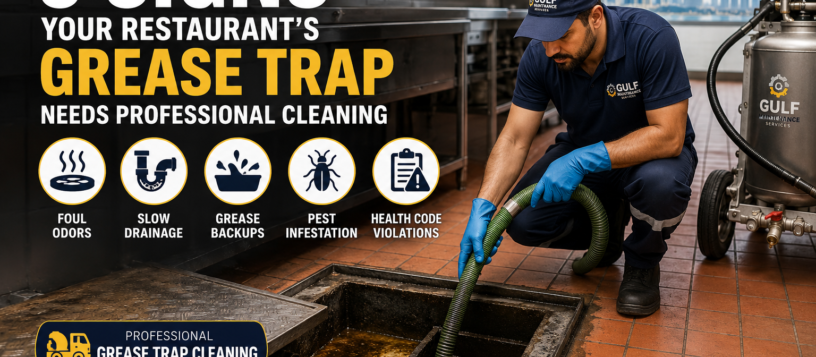
Every restaurant kitchen in Dubai runs on a tight rhythm: orders firing, pans clattering, staff moving fast. Nobody has time to think about the grease trap sitting quietly under the sink or tucked away near the back exit. And that’s exactly the problem. Grease traps fail silently, right up until the moment they don’t. One missed cleaning cycle, and you’re staring at a flooded floor drain during Friday night service.
Here’s the part most owners don’t realize: a failing grease trap doesn’t just break without warning. It talks to you first. Slow drains, strange smells, gurgling pipes these are all early signals, and if you catch them in time, a routine grease trap cleaning service in Dubai is all it takes to fix things. Wait too long, and you’re looking at a shutdown, a health inspection failure, or an emergency plumbing bill that could’ve been avoided entirely.
This guide breaks down the five clearest warning signs, explains the science behind them, and walks you through exactly what a professional cleaning looks like — so you can make an informed call before your kitchen forces the decision for you.
What a Grease Trap Actually Does (And Why It Fails)
Think of a grease trap as a bouncer for your plumbing system. Every time your kitchen drains hot, greasy water from washing pans, rinsing fryer baskets, or dumping old cooking oil, that water passes through the trap first. Inside, it cools down. As it cools, fat and oil separate and float to the top, while solids sink to the bottom. Clean water continues to the sewer line; the grease and solids stay behind, trapped.
That’s the design. But traps have a limited holding capacity, and Dubai kitchens generate grease fast, especially anywhere frying, grilling, or heavy sauce work happens. Once the trap fills up, it can’t separate anything anymore. Everything it was supposed to catch just flows straight through into your pipes instead.
Dubai Municipality doesn’t treat this lightly, either. Restaurants are required by law to maintain working grease traps and keep cleaning records available for inspection. Skip maintenance, and you’re not only risking a plumbing emergency; you’re risking fines and, in repeat cases, a temporary closure notice. Regular restaurant grease trap cleaning in Dubai isn’t optional maintenance; it’s part of running a compliant kitchen.
Sign #1: Your Sinks and Floor Drains Are Draining Slower Than Usual
This one sneaks up gradually, which is exactly why it gets ignored. Water that used to vanish in a few seconds now lingers in the sink. Floor drains near the dish pit start pooling during a busy dinner rush.
It happens because grease coats the inside of your pipes, narrowing the space water can flow, similar to how plaque narrows an artery over time. Nobody notices the first week. By week three or four, staff is working around standing water like it’s normal.
It isn’t normal, and it won’t fix itself. Left alone, slow drainage becomes a full blockage, usually at the worst possible moment. If your kitchen’s drains have been sluggish more than once in the past couple of weeks, that’s a direct signal your trap needs grease trap maintenance from Dubai professionals.
Sign #2: A Sour, Rotten Smell Keeps Showing Up Near the Kitchen
Grease trap odor is unmistakable once you’ve smelled it — sour, faintly rotten, like spoiled oil mixed with old eggs. It doesn’t fade with regular kitchen cleaning because it isn’t coming from the kitchen surfaces at all.
Why the Smell Happens
Trapped grease and food waste don’t just sit there quietly. Bacteria break the organic material down, and that process releases gas the same gas responsible for the smell. In Dubai’s heat, this happens faster than it would in a cooler climate, since warm temperatures speed up bacterial activity inside the tank.
What Makes the Odor Worse
A few kitchen habits tend to accelerate this problem:
- Frequent frying or heavy oil use fills the trap faster, giving bacteria more material to break down
- Long gaps between cleanings allow waste to decompose for weeks instead of days
- Poor airflow around the trap traps the gas instead of letting it disperse
- High ambient heat, especially in outdoor or semi-covered kitchen areas, speeds up decomposition
A grease trap bad smell rarely goes away on its own, and masking it with air fresheners only delays the inevitable. If customers can smell it near your dining area, that’s already a problem worth fixing immediately.
Sign #3: The Trap Overflows or Backs Up Into the Kitchen
This is the sign every restaurant owner dreads, and unfortunately, it’s more common than people assume. A grease trap overflowing in restaurant kitchens means the tank has reached full capacity; there’s simply no room left for new waste to settle.
Instead of holding grease back, the trap pushes wastewater in the opposite direction, straight back up through your drains. You’ll see it bubbling up from a floor drain, pooling near the dishwashing station, or rising through a sink mid-shift. It’s disruptive, unhygienic, and often shuts down part of your kitchen while staff scramble to clean up.
Overflow doesn’t happen without warning. It’s the final stage after weeks of ignored smaller signs — slow drainage, gurgling, odor. Catch those earlier signals, and you’ll likely never reach this point. Beyond the mess, an overflow creates real hygiene risks too: greasy water on kitchen floors is a slip hazard, and if it reaches a food prep surface, that’s an instant health inspection failure waiting to happen.
Sign #4: Plumbing Clogs Keep Coming Back
If a plumber has visited your restaurant more than once in the past few months for clogged pipes, there’s a good chance the grease trap is the actual root cause, not just bad luck with old plumbing.
Here’s the connection: once a trap is full, grease that should’ve been captured keeps traveling down the line and hardens further along the pipe — often somewhere harder to reach and more expensive to service. What looks like a plumbing issue is often a grease trap issue wearing a different hat.
A few signs point specifically to grease-related clogs:
- Gurgling sounds when water runs, caused by air trapped behind a partial blockage
- Multiple fixtures backing up together, which usually means a shared line is affected downstream
- Repeated snaking or jetting that fixes the symptom for a week or two, then the clog returns
Treating the pipes without touching the trap is a temporary fix at best. The blockage comes back, the plumber comes back, and the costs keep adding up. Addressing the source with proper commercial grease trap cleaning Dubai services solves the actual problem instead of managing it on repeat.
Sign #5: A Thick Grease Layer Is Visible Inside the Trap
If someone on your team ever opens the trap lid for a check, take a moment to actually look inside. Some grease floating on top is normal. A layer that dominates the tank is not.
Most service providers and local guidelines recommend scheduling a cleaning once the grease and solids layer reaches roughly a quarter of the trap’s total depth. Cross that line, and the trap’s ability to separate grease from water drops sharply, meaning grease starts passing straight through into your plumbing system instead of staying put.
During a visual check, watch for:
- A solid, hardened grease layer sitting across the surface of the water
- Food solids and debris built up along the bottom of the tank
- Water that looks murky or oily even near the outlet side
- Grease thick enough to resist being stirred or broken up with a rod
Most kitchen teams aren’t trained to check this regularly, and honestly, it’s not a task anyone volunteers for. That’s exactly why scheduled kitchen grease trap cleaning beats relying on occasional visual spot checks.
How Often Should a Grease Trap Be Cleaned?
Owners ask this constantly, and the honest answer depends on how much grease your kitchen actually produces. That said, general benchmarks work for most Dubai restaurants.
Kitchens with heavy fry stations, grills, or rich sauces typically need cleaning every 4 to 6 weeks. Mid-volume restaurants usually fall into a 6-to-8-week cycle. Smaller cafes with lighter menus can often stretch to 8 or even 12 weeks between services, though this still depends on daily covers and menu style.
Grease trap cleaning frequency shouldn’t be guesswork. A professional technician can assess your specific grease output on the first visit and set a realistic schedule from there. Sticking to a fixed calendar — instead of reacting once problems appear is almost always cheaper than emergency service calls.
What Actually Happens During a Professional Cleaning
If you’ve never watched this process happen, here’s what to expect from a proper professional grease trap cleaning Dubai service:
- Inspection first: the technician checks grease thickness, trap condition, and looks for any visible damage before starting
- Pumping out waste: specialized vacuum equipment removes grease, solids, and wastewater from the tank
- Manual scraping: hardened grease stuck to the walls and internal baffles gets physically cleared away
- Flushing the system: remaining residue in the trap and nearby pipes gets flushed clean
- Compliance documentation: waste disposal follows Dubai Municipality regulations, and you get a service record for your files
- Final inspection: the technician confirms everything’s working correctly before leaving
Depending on trap size and how much buildup has accumulated, this usually takes 30 minutes to 2 hours. A good provider schedules around your service hours, so you’re not losing kitchen time during peak periods.
Common Grease Trap Problems Beyond the Basics
There’s more to grease trap trouble than the five signs above. A few recurring issues catch restaurant owners off guard more often than you’d expect. Undersized traps are a bigger issue than most people realize, especially for restaurants that expanded their menu or seating without upgrading their plumbing to match. A trap sized for a 30-seat cafe simply can’t keep pace with a 100-seat restaurant running a full fried menu. If cleanings keep happening and problems keep returning anyway, the trap itself might just be too small for what your kitchen produces now.
Bad disposal habits speed up buildup considerably. Pouring used cooking oil straight down the drain, skipping the pre-wipe on greasy pans, or never training new staff on proper waste handling all of it fills the trap faster than it should. Small changes, like scraping plates into a bin before washing or collecting used oil separately, genuinely extend the time between services.
And then there’s corrosion. Older metal traps take a beating from constant grease and moisture exposure, and damage often goes unnoticed until a technician spots it during a routine visit. Catching this early during a scheduled cleaning avoids a much costlier replacement down the line.
What It Actually Costs to Ignore This
It’s tempting to push grease trap cleaning down the priority list when budgets are tight. But the math rarely works in your favor once you factor in the alternative.
A missed cleaning cycle that ends in an overflow means emergency plumbing costs, a day or more of disrupted operations, and a real risk of health code violations if inspectors happen to show up during the aftermath. Dubai Municipality inspections don’t leave much room for excuses; a poorly maintained trap can mean fines, and repeat violations escalate from there.
There’s a reputational cost too, and it’s harder to put a number on. A bad smell during someone’s dinner, a visibly flooded floor near the dining room, a closure notice on the door none of that is easy to bounce back from in a market as competitive as Dubai’s restaurant scene. Prevention costs far less than damage control, both financially and reputationally.
Choosing a Grease Trap Cleaning Partner You Can Trust
Not every cleaning service delivers the same standard, and the wrong choice can leave you dealing with identical problems within weeks. A few things separate a dependable partner from a rushed job:
- Proper Dubai Municipality licensing for grease waste collection and disposal
- Clear documentation provided after every visit, so your compliance records stay up to date
- Scheduling flexibility that fits around your operating hours instead of disrupting them
- Technicians who actually inspect, not just pump and leave, catching underlying issues before they become expensive ones
A provider worth keeping treats your grease trap as an ongoing responsibility, not a one-time job. They’ll flag problems before they escalate, recommend a schedule that fits your kitchen’s real output, and keep your compliance paperwork ready without you having to chase them down every time an inspector calls.
Frequently Asked Questions
1. What are the signs your grease trap needs cleaning?
Watch for slow-draining sinks, a persistent sour smell near the kitchen, water overflowing or backing up from drains, plumbing clogs that keep returning, and a thick, visible grease layer when the trap is checked.
2. When should I clean a grease trap?
Clean it once the grease and solids layer reaches roughly 25% of the tank’s depth, or right away if you notice slow drainage, odor, or backup. Most restaurants avoid guesswork by keeping a fixed cleaning schedule instead.
3. How often should a grease trap be cleaned in a restaurant?
High-volume kitchens generally need cleaning every 4 to 6 weeks, mid-volume kitchens every 6 to 8 weeks, and smaller cafes every 8 to 12 weeks, depending on daily menu and covers.
4. Why does my grease trap still smell bad after cleaning?
Lingering odor after a cleaning often points to residue left in the connecting pipes, a worn trap seal, or buildup further down the line that wasn’t cleared. Ask your provider to check the surrounding plumbing too, not just the trap itself.
5. Is professional grease trap cleaning legally required in Dubai?
Yes. Dubai Municipality requires restaurants to keep grease traps functional and maintain cleaning records for inspection. Non-compliance can lead to fines, and repeat violations can result in stricter enforcement.
Final Thoughts
A grease trap will never be the most exciting piece of equipment in your kitchen, but it’s one of the few that can shut your restaurant down entirely if it’s neglected long enough. Slow drains, bad smells, overflow, recurring clogs, visible grease buildup — these five signs are your kitchen’s way of asking for attention before things get genuinely bad.
The fix doesn’t need to be complicated. A consistent cleaning schedule, a reliable service provider, and a bit of staff awareness go a long way toward avoiding the mess, the cost, and the compliance headaches that come with a neglected trap. If it’s been a while since your last service, that’s reason enough to book one now.
