
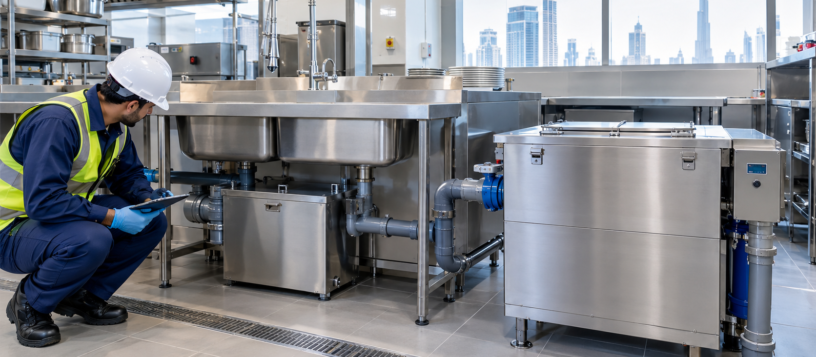
Every plate that leaves a commercial kitchen leaves something behind in the sink. Cooking oil, animal fat, and food residue wash down the drain, cool in the pipes, and harden into thick deposits. In a busy restaurant, café, or hotel kitchen, those deposits build up fast and block drains.
A grease trap stops that problem at the source. It slows the wastewater leaving your kitchen so fats, oils, and grease (FOG) float to the top while the water moves on. Solids settle at the bottom. The cleaner water in the middle flows out to the drainage system. Without this step, FOG enters the drains and causes blockages, bad odours, and costly emergency repairs.
Dubai’s food businesses face extra pressure. Kitchens run long hours, menus lean on fried and oil-rich dishes, and authorities expect food premises to manage grease properly. Restaurants, cafés, hotels, catering units, and cloud kitchens all need a system that fits how they cook.
Not every unit suits every kitchen. A small café with one sink needs something very different from a hotel kitchen serving hundreds of covers. The wrong type or capacity leads to overflow, constant cleaning, and downtime.
This guide explains the main types of grease traps, compares passive and automatic systems, and shows how to size a unit for your kitchen. It also covers installation locations and common mistakes. If you plan grease trap installation in Dubai restaurants, start with what your kitchen actually produces. Getting the grease trap installation Dubai kitchens need right the first time saves money on every later cleaning. You can also see how regular upkeep works on our grease trap cleaning service page.
Types of Grease Traps Used in Commercial Kitchens
The main types of grease traps differ in size, operation, and the kitchens they suit. Most commercial kitchens use one of three systems.
Passive Grease Traps
Passive grease traps rely on gravity. Wastewater enters the unit, slows down, and cools. Fats and oils rise to the surface, solids sink, and the water flows out. No electricity is needed.
Most small and mid-sized kitchens use them. Compact under-sink models fit beside a single sink or dishwasher. Larger floor-mounted units handle more flow.
Installation is simple. A technician connects the inlet and outlet pipes, and the unit starts working. Maintenance takes more effort. Someone must remove the grease by hand and clean the trap on a regular schedule. Skipped cleaning lets grease escape downstream.
Passive units suit cafés, small restaurants, and food counters with moderate grease output and tight budgets.
Automatic Grease Removal Units
Automatic grease removal units, often called AGRUs, separate grease in a similar way but remove it without manual skimming. A heated or mechanical skimmer lifts grease from the surface and moves it into a collection container.
These units need a power supply, and many need space for the container and controls. Installation takes more planning than a passive unit. Daily upkeep drops because the system removes grease on its own. Staff still empty the container and service the moving parts.
Automatic units work well in high-volume kitchens such as hotels, busy restaurants, food courts, and central production kitchens. They also help sites where staff have little time for skimming.
Large External and Underground Grease Interceptors
Large kitchens and multi-tenant buildings often use bigger interceptors installed outside the building or below ground. These tanks hold a large volume of wastewater, which gives grease more time to separate.
Installation involves excavation or external plumbing, so it needs more planning and coordination. Cleaning usually requires a vacuum truck and trained crews instead of kitchen staff. Hotels, malls, and large food operations often choose this option, depending on the property.
Some kitchens combine systems. An under-sink unit may protect the pot-wash area while a larger interceptor handles the main drain. A site assessment shows which setup fits.
Passive vs Automatic Grease Trap: Key Differences
The passive vs automatic grease trap decision comes down to budget, kitchen volume, and how much daily labour you can spare. This section compares the two on the points that matter most.
Operation, Installation, and Efficiency
A passive trap uses gravity and holds grease until someone removes it. An automatic unit actively skims grease from the water into a container.
Passive traps install quickly and need no power. Automatic units need electrical connections and more floor space, so installers plan the layout first.
Efficiency depends on upkeep. A passive trap works well when staff clean it on time, but performance drops as grease fills the chamber. An automatic unit removes grease continuously, so performance stays steadier between services. In heavy-use kitchens, that difference matters.
Cleaning Requirements and Maintenance Costs
Passive traps need frequent manual cleaning. Busy kitchens may clean them often, and the work takes time and labour. Automatic units cut that daily workload, yet they bring service needs of their own, including checks on moving parts and the power supply.
Costs follow the same pattern. Passive units cost less to buy and install. Automatic units cost more upfront, but they can lower labour time and reduce the risk of missed cleaning. Compare the full cost over several years, not just the purchase price.
Which Suits Which Restaurant Size
Small cafés, kiosks, and low-volume restaurants usually do well with passive units. Their grease output stays manageable, and staff can clean the trap on schedule.
Medium to large restaurants, hotel kitchens, and food courts often benefit from automatic units because of high daily wastewater and grease. A kitchen that struggles to keep up with cleaning is a strong candidate for an upgrade.
Base the choice on your actual flow and menu, not business size alone.
How to Choose the Right Grease Trap Size for a Restaurant
Correct sizing decides whether your grease trap works or fails. The grease trap size for restaurant kitchens depends on how much wastewater flows through the unit and how long that water stays inside. Too little time means grease leaves with the water. Size the unit around real kitchen activity, not guesswork.
Consider these factors:
- Total wastewater flow from all connected fixtures
- Sink capacity and number of compartments
- Dishwashing equipment and its discharge rate
- Type of cooking and oil content of the menu
- Peak-hour volume, not the daily average
- Number of food preparation stations
An undersized unit fills quickly. Staff clean it constantly, and grease starts to pass through to the drains once the chamber is full. Overflow, slow sinks, and odours follow, and the kitchen may stop service for emergency work.
Bigger is not always better. An oversized unit costs more to buy, takes up more space, and may hold wastewater long enough to create odours. Assess your actual requirements first, then choose a capacity that matches them with room for reasonable growth. A qualified installer can calculate flow and recommend the right model.
What Factors Affect Grease Trap Installation Requirements in Dubai?
Several site conditions shape installation requirements. Start with the kitchen layout. The position of sinks, dishwashers, and floor drains decides which fixtures connect to the trap and how far wastewater travels. Available space comes next. Under-sink units need clear room beneath the counter. Floor-mounted and automatic units need floor space, ventilation, and in some cases power. External systems need outdoor space and a clear drainage route.
Drainage connections matter too. Installers check pipe sizes, slopes, and connection points to the building’s drainage. Poor connections cause backflow and slow draining even when the trap is right. Accessibility and maintenance access also count. Technicians must reach the lid, inlet, and outlet to clean and inspect the unit. A trap hidden behind equipment gets ignored.
Wastewater volume and equipment location then set the size and number of units your kitchen needs. This is why restaurants should assess their premises before buying. A site visit reveals limits that a catalogue cannot show. It prevents expensive changes after fit-out, and it makes grease trap installation in Dubai businesses run smoothly from day one.
Where Should a Grease Trap Be Installed in a Commercial Kitchen?
The right location depends on the kitchen and the building. Three setups are common. Under-sink units sit directly beneath a sink or dishwasher station. They suit small kitchens with limited space and catch grease close to the source. Staff reach them easily, though cupboard space is tight.
Indoor floor-mounted installations sit inside the kitchen or a back-of-house area. They handle higher flow than under-sink units. Placing them near the main drain lines keeps pipe runs short. Leave enough clearance around the unit to remove the lid and clean it.
Larger external or underground interceptors sit outside the building, often in a yard, service area, or below ground. They suit high-volume operations and properties with little kitchen space. Cleaning crews need vehicle access.
Choose the location using accessibility, drainage connections, and convenience for maintenance. Each property differs, and building or authority requirements may affect where a unit can go. Check the rules for your premises and ask an installer to assess the layout before you decide.
Grease Trap Installation and Maintenance Requirements
A professional installation follows clear steps. A site assessment checks the kitchen layout, fixtures, and drainage. The installer then selects a capacity based on flow and kitchen activity. Next, the team positions the unit with proper access, connects the inlet and outlet to the drainage, and tests the system for leaks and flow. A final inspection confirms the unit works as intended.
Dubai Municipality publishes grease trap guidance, and licensed contractors work under its supervision. Check current requirements for your premises before you install.
Maintenance keeps the system working. Remove grease and solids regularly, and clean the trap before it fills. Cleaning frequency depends on kitchen volume, menu, and unit size, so a fry-heavy kitchen needs more frequent service than a small café. Inspect lids, seals, and pipes for wear. Slow drains and odours signal a full unit.
Keep service records, because inspectors may ask for them. Good grease trap installation in Dubai kitchens can be maintained easily with clear access and a cleaning plan. Many restaurants hire professional grease trap cleaning so the work happens on schedule and the waste reaches the right collector.
Common Grease Trap Sizing and Installation Mistakes
Many grease trap problems trace back to avoidable decisions made during planning. These mistakes appear again and again in restaurant kitchens:
- Choosing an undersized unit to save money
- Ignoring total wastewater volume
- Picking an unsuitable installation location
- Overlooking maintenance access
- Forgetting future kitchen growth
An undersized unit and ignored wastewater volume cause the same result. Grease passes through, drains block, and staff clean the trap constantly. The kitchen pays in labour and lost service time.
A poor location or blocked access makes cleaning difficult. Staff skip tasks they cannot reach, so grease builds up and odours spread. Technicians also spend longer on each visit, which raises service costs.
Ignoring growth is a quieter mistake. A restaurant that adds seats, equipment, or a delivery menu produces more wastewater. A trap sized for the old kitchen soon falls behind, and the business faces another installation. Plan capacity for realistic growth from the start.
Frequently Asked Questions
What are the main types of grease traps used in restaurants?
Restaurants mainly use passive grease traps, automatic grease removal units, and large external or underground interceptors. Passive units rely on gravity and manual cleaning. Automatic units skim grease mechanically. Large interceptors suit high-volume kitchens. The best option depends on kitchen size, menu, and available space.
What is the difference between passive and automatic grease traps?
Passive grease traps use gravity, cost less, need no power, and require regular manual cleaning. Automatic units remove grease with a skimmer, cost more upfront, and cut daily labour. Passive units suit smaller, lower-volume kitchens, while automatic units suit busy kitchens with heavy grease output.
How do I calculate the right grease trap size for a restaurant?
Start with the wastewater flow from sinks, dishwashers, and other fixtures. Then consider peak-hour use, menu type, and the number of preparation stations. A qualified installer uses these figures to recommend a capacity. Avoid guessing, because undersized and oversized units both create problems.
Where should a commercial grease trap be installed?
Common locations include under the sink, inside the kitchen or back-of-house area, and outside or underground for larger systems. The right spot offers easy access for cleaning, a practical drainage connection, and enough space. Property layout and local requirements also influence the decision.
How often should a restaurant grease trap be cleaned?
Frequency depends on kitchen volume, menu, and unit size. Busy kitchens that cook oily food need cleaning more often than small, low-volume ones. Watch for slow drains and odours, follow your installer’s guidance, check local requirements, and keep service records.
Conclusion
Choosing a grease trap means matching three things to your kitchen: the type, the capacity, and the location. Passive units suit smaller kitchens with manageable grease output. Automatic units help busy kitchens cut daily labour. Large interceptors serve high-volume sites. Size the unit to real wastewater flow and peak hours, and place it where technicians can reach it easily.
Mistakes in any of these areas lead to blocked drains, odours, and avoidable downtime. A proper site assessment prevents most of them.
Good planning turns grease trap installation for Dubai restaurants and food businesses into a one-time investment that serves the kitchen for years. Regular cleaning keeps it that way.
Gulf Maintenance helps restaurants, cafés, hotels, and commercial kitchens with grease trap installation and maintenance. Contact Gulf Maintenance today to discuss your kitchen and get the right system in place.
