
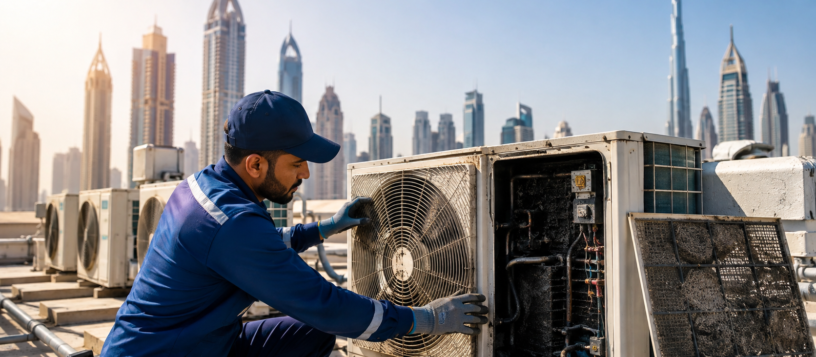
Summer here doesn’t ease in. One week it’s warm; the next, you’re hitting 45°C, and your AC hasn’t had a day off since. For anyone living or running a business in the UAE, cooling isn’t optional; it’s basic infrastructure. Still, every single year, homeowners and shop owners across Dubai, Abu Dhabi, and Sharjah end up without cooling at exactly the wrong moment, usually mid-July, usually during a heatwave.
This guide covers the common HVAC problems in UAE summers that we see repeat year after year, why the local climate makes them worse, and what actually helps whether you’re dealing with a villa, a small shop, or a full commercial building.
Why UAE Summers Are So Tough on HVAC Systems
Most places give their cooling systems a break in spring and autumn. Not here. From May through September, an AC unit in the UAE might run 16 to 20 hours a day, often more, with barely any downtime to recover.
Then there’s the dust. Fine desert particles get into everything coils, filters, fan blades — and settle in faster than most people expect. Add coastal humidity into the mix, plus the occasional power fluctuation, and you’ve got a system under constant pressure. That’s really the core reason HVAC problems in properties in the UAE spike so hard between June and September. It’s not that the equipment is badly made. It’s that nothing gets this kind of workload anywhere else.
How UAE Weather Patterns Affect Your AC’s Lifespan
It’s easy to assume heat alone is the enemy, but humidity plays a bigger role than people give it credit for. In coastal cities, your AC isn’t just cooling air it’s pulling moisture out of it too, which means the compressor is doing double duty most of the day. Go inland, and the problem flips. Drier air, sure, but far more sand and grit, especially when shamal winds pick up. That grit works its way into places filters can’t always catch.
Put it together, and you get a simple truth: AC units in the UAE tend to age faster than the manufacturer’s spec sheet suggests. A brand might promise 12 to 15 years of service life, but without adjusted maintenance for local conditions, plenty of units start struggling well before that.
Top Common HVAC Problems in UAE Summers
Here’s where it gets specific. These are the common HVAC problems in UAE summers that technicians deal with on repeat, almost like clockwork once the heat sets in.
HVAC Overheating
Your outdoor unit’s whole job is to dump heat into the outside air. The problem is, when that air is already close to 45°C, the unit has to work harder just to do what it normally does. That’s HVAC overheating in a nutshell, and it’s one of the most common summer complaints we hear about.
A lot of units shut themselves off when they overheat; it’s a built-in safety measure, but it means you lose cooling right when you need it most. Blocked vents, poor clearance around the outdoor unit, or a system that was undersized from the start all make this worse. If your AC keeps tripping during the hottest part of the afternoon, this is usually why.
AC Refrigerant Leaks
Refrigerant does the actual work of pulling heat out of your indoor air. No refrigerant, no cooling — it’s that simple.
AC refrigerant leaks tend to start small, at a joint, valve, or coil that’s corroded or has come loose over time. You might notice the air isn’t as cold as it used to be, a faint hissing near the unit, or, oddly enough, ice forming on the coils despite the heat outside. One thing worth knowing: refrigerant doesn’t just deplete on its own through normal use. If levels are low, there’s a leak somewhere, and it needs to be found and sealed.
Dirty Air Filters
People underestimate this one constantly. Dirty air filters choke off airflow, and your system compensates by working harder than it should — which shows up in your electricity bill long before it shows up as a breakdown.
Dust builds up fast here, especially during windy spells or a sandstorm. A filter that would last three months somewhere else might need swapping every three to four weeks during peak UAE summer. Skip it too long, and you risk frozen coils, then eventually a compressor that’s paid the price for months of extra strain.
AC Compressor Problems
Think of the compressor as the engine of the whole system. When it goes, cooling stops, even if the fan is still spinning away like nothing’s wrong.
AC compressor problems rarely show up out of nowhere. There’s usually a build-up of clicking or humming that wasn’t there before, the unit taking longer to start, or it running nonstop without actually cooling anything. Catching this early matters, because compressors aren’t cheap to replace, and most people would rather spend a little now than a lot later.
Poor Airflow
Weak airflow, or airflow that’s fine in one room and nonexistent in another, is another summer regular. Poor airflow has a handful of usual suspects: clogged filters, blocked ductwork, a blower motor on its way out, or sometimes something as simple as a couch pushed in front of a vent.
Whatever the cause, the outcome’s the same: some rooms just won’t cool down no matter how far you drop the thermostat. And the system keeps running longer to compensate, which costs you money without actually solving anything.
Signs Your AC Is About to Break Down
Breakdowns rarely happen out of nowhere. Your system usually tells you something’s wrong well before it quits for good. Keep an eye out for:
- Warm or inconsistent air, even with the thermostat set as low as it goes
- Strange noises: grinding, rattling, clicking, or a sharp hiss
- Electricity bills creeping up with no real change in how you’re using the AC
- Short cycling, where the unit switches on and off more than usual
- Water pooling or leaking near the indoor unit
- Odd smells on startup, which often point to mold or a burnt component
- Constant running without the room ever actually reaching temperature
Notice two or three of these together, and it’s worth getting someone to look at it before it turns into a full breakdown in the middle of a heatwave.
AC Problems in Summer: What Makes This Season Different
AC problems in summer aren’t just more common; they hit harder. A broken AC in December is annoying. A broken AC in July, with temperatures pushing 45°C, can be genuinely dangerous, especially for kids, elderly family members, or anyone with a health condition that’s sensitive to heat.
There’s a practical side too. Once the heat peaks, every technician in the city is booked solid. Same-day appointments get harder to find, and a repair that would normally take an afternoon might stretch into a few days. It’s one more reason prevention beats reaction during these months — waiting things out just isn’t a great strategy here.
DIY Checks You Can Do Before Calling a Technician
Not everything needs a service call. A few quick checks can save you both time and a callout fee, or at least help you explain the problem clearly when you do reach out.
Start with the basics: check your thermostat settings and batteries. It sounds too simple to matter, but a dead thermostat battery causes more “broken AC” panic than you’d think. After that, walk outside and check the condenser unit for leaves, debris, or the occasional bird’s nest blocking airflow — clear whatever you find. While you’re at it, check the circuit breaker too. A tripped breaker is a two-second fix, no technician required.
If the filter’s grey or visibly clogged when you pull it out, replace it before anything else. Honestly, this one step solves a surprising number of “weak cooling” complaints all by itself. If you’ve done all that and nothing’s changed, that’s your cue to call a professional.
The Cost of Ignoring HVAC Problems in UAE Summers
Putting off a repair rarely saves money in the end. A small refrigerant leak, left alone, can wear down the compressor until an AED 300 fix turns into an AED 3,000 replacement. Filters ignored for months put extra strain on the whole system and shave years off its working life. Wait until the unit fails outright, and you’ll almost always pay more than you would have for catching it early.
How to Prevent HVAC Breakdowns This Summer
Here’s the encouraging part: most summer breakdowns are avoidable. A bit of consistent upkeep goes a long way. Some practical HVAC maintenance tips for hot weather worth building into your routine:
- Swap filters monthly during peak summer rather than sticking to the usual three-month schedule
- Give the outdoor unit breathing room: clear dust, leaves, and debris, and leave at least 60cm of open space around it
- Book a professional tune-up before summer really kicks in, ideally March or April
- Get refrigerant levels checked yearly, since low levels almost always mean there’s a leak somewhere
- Insulate exposed ductwork so cool air actually reaches your rooms instead of leaking out along the way
- Resist setting the thermostat too low; it forces the compressor to work harder than it needs to
- Run ceiling fans alongside the AC to help circulate air and take some load off the system
None of this costs much. But together, these habits cut your breakdown risk significantly. At the end of the day, regular HVAC maintenance is the single biggest difference between a home that coasts through summer and one that’s calling for emergency repairs every few weeks.
Commercial HVAC Maintenance UAE: A Different Set of Priorities
Business owners are playing a different game than homeowners. When a shop, restaurant, or office loses cooling, it’s not just discomfort; it’s lost customers, lost productivity, sometimes lost inventory.
Commercial HVAC maintenance UAE needs tend to be bigger in scale — larger systems, longer run times, sometimes close to 24/7 during peak summer for malls or office towers. That usually means:
- Changing filters more often, since higher foot traffic stirs up more dust
- Quarterly inspections instead of a once-a-year check
- A backup cooling plan for anything critical, like server rooms or cold storage
- Training staff to spot early warning signs and flag them quickly
- A maintenance contract with someone who actually understands commercial-scale systems, not just residential ones
It’s tempting, especially on a tight budget, to put maintenance off until something breaks. But a few hours of lost business or a fridge full of spoiled stock usually costs more than the routine upkeep would have.
AC Breakdown Prevention: Building a Simple Seasonal Habit
The real trick to AC breakdown prevention is treating it like a habit, not a one-off task. Set a monthly reminder to check filters. Book your seasonal tune-up before the heat peaks, not after something’s already gone wrong. Keep a rough log of when maintenance happened — it doesn’t need to be fancy, just enough that you’re not relying on memory alone.
It barely takes any time, and it saves real money over the years. Systems that get consistent attention simply last longer and break down far less than the ones that only get looked at once something’s already wrong.
When to Call a Professional
Some things are fine to check yourself — filters, vents, basic cleaning. Others aren’t worth the risk. Call a professional if you’re dealing with a refrigerant leak, an electrical smell, a breaker that keeps tripping, or a compressor that sounds like it’s struggling. Messing with refrigerant or electrical components without training isn’t just risky — it can void your warranty too. Simple rule of thumb: if fixing it means opening the unit past the filter compartment, that’s a technician’s job.
Frequently Asked Questions
1. What are the most common HVAC problems in UAE summers?
Overheating, refrigerant leaks, dirty air filters, compressor strain, and poor airflow top the list. These tend to get worse between June and September when the heat and system workload both peak.
2. How often should I service my AC during UAE summer months?
Get a professional inspection before summer starts, then check filters every three to four weeks once peak heat hits. Commercial systems generally need quarterly servicing.
3. Why does my AC blow warm air even when it’s running?
Usually it’s one of three things: low refrigerant, a clogged filter, or a compressor that’s struggling. A technician can pinpoint which one quickly.
4. Can dirty air filters really cause an AC breakdown?
Yes, more often than people expect. Clogged filters restrict airflow, overwork the compressor, and can lead to frozen coils — and eventually, full system failure if left too long.
5. What’s the best way to prevent AC breakdowns in extreme heat?
Stay consistent — clean filters monthly, keep the outdoor unit clear, book seasonal tune-ups, and don’t push the thermostat lower than it needs to be. Small habits, real difference.
Final Thoughts
The common HVAC problems in UAE summers covered here overheating, refrigerant leaks, dirty filters, compressor strain, poor airflow all come back to the same point: they’re mostly preventable if you’re paying attention. You don’t need to wait for a breakdown to act. A handful of simple habits, plus timely professional help when it’s actually needed, will carry your system through even the roughest months without much drama.
Whether it’s one villa or a whole commercial building you’re responsible for, staying ahead of these problems protects your comfort, your budget, and honestly, your patience.
